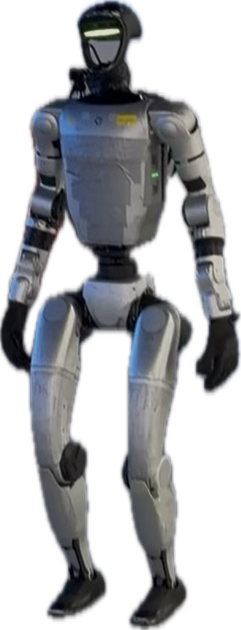
Embodied navigation connects intelligent agents with the
physical world and serves as a fundamental capability for
achieving general robotic intelligence. However, the
availability and quality of navigation data have long limited
the generalization ability of Vision-and-Language Navigation
(VLN) systems and their capacity to handle long-horizon tasks.
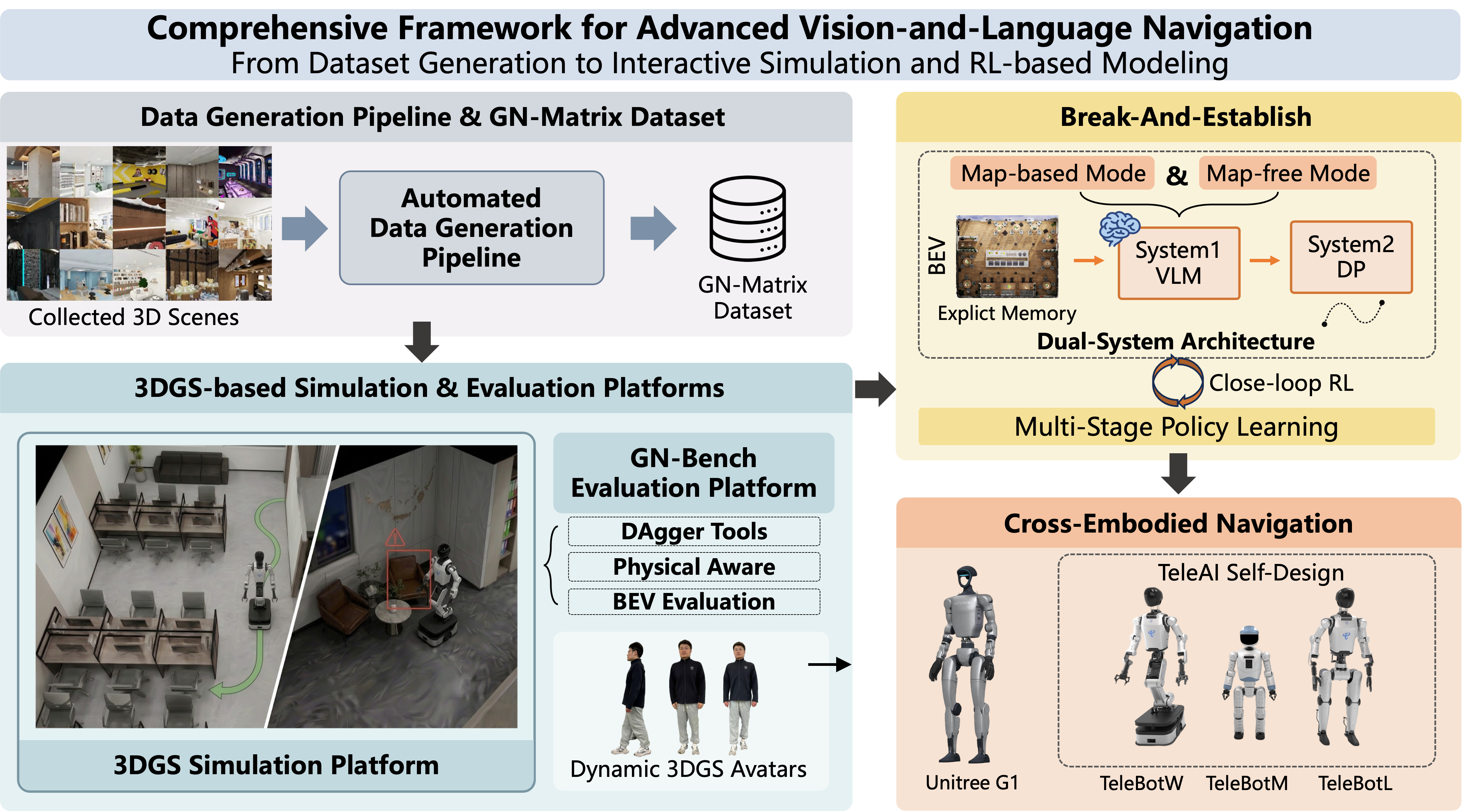
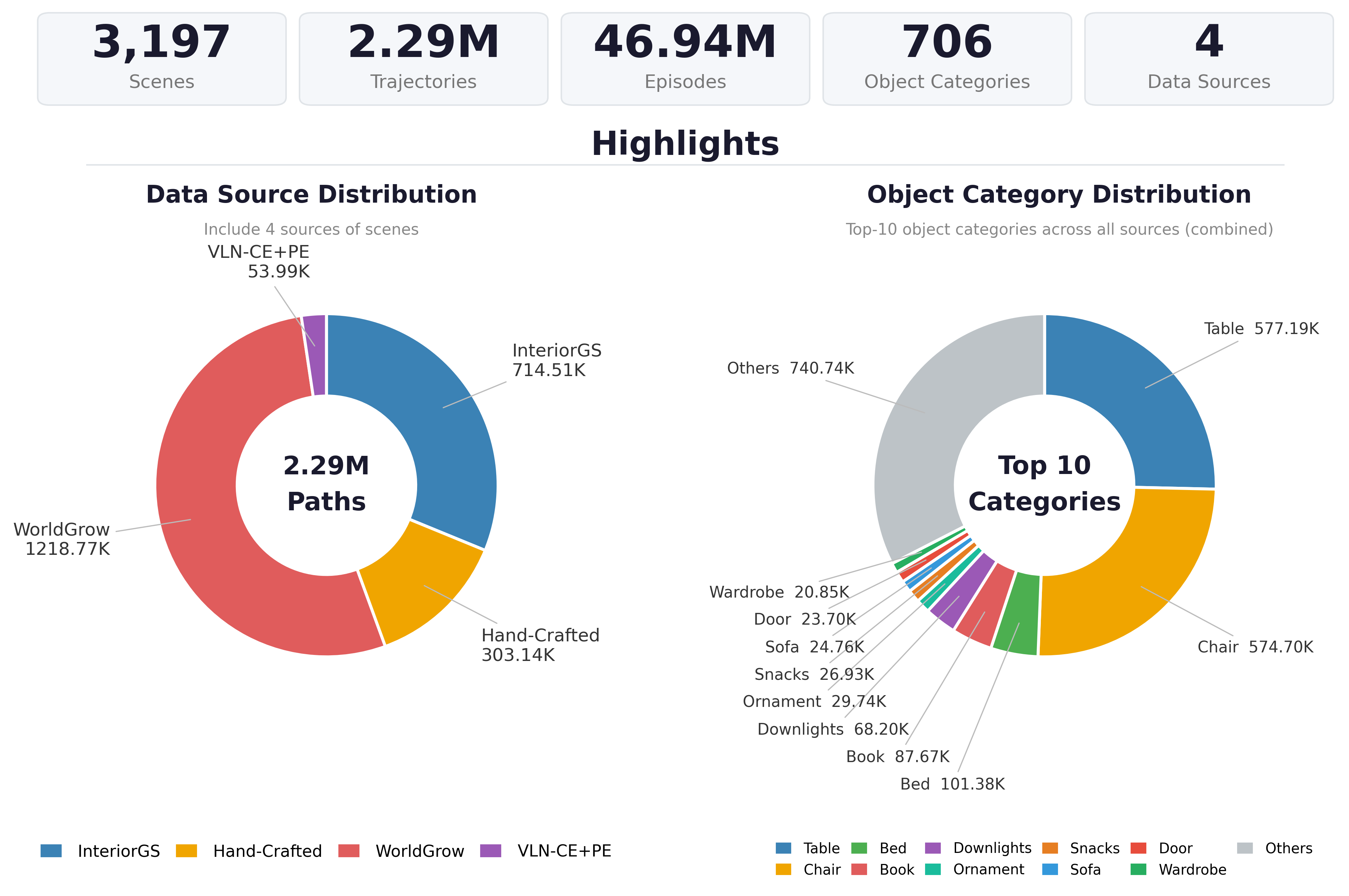
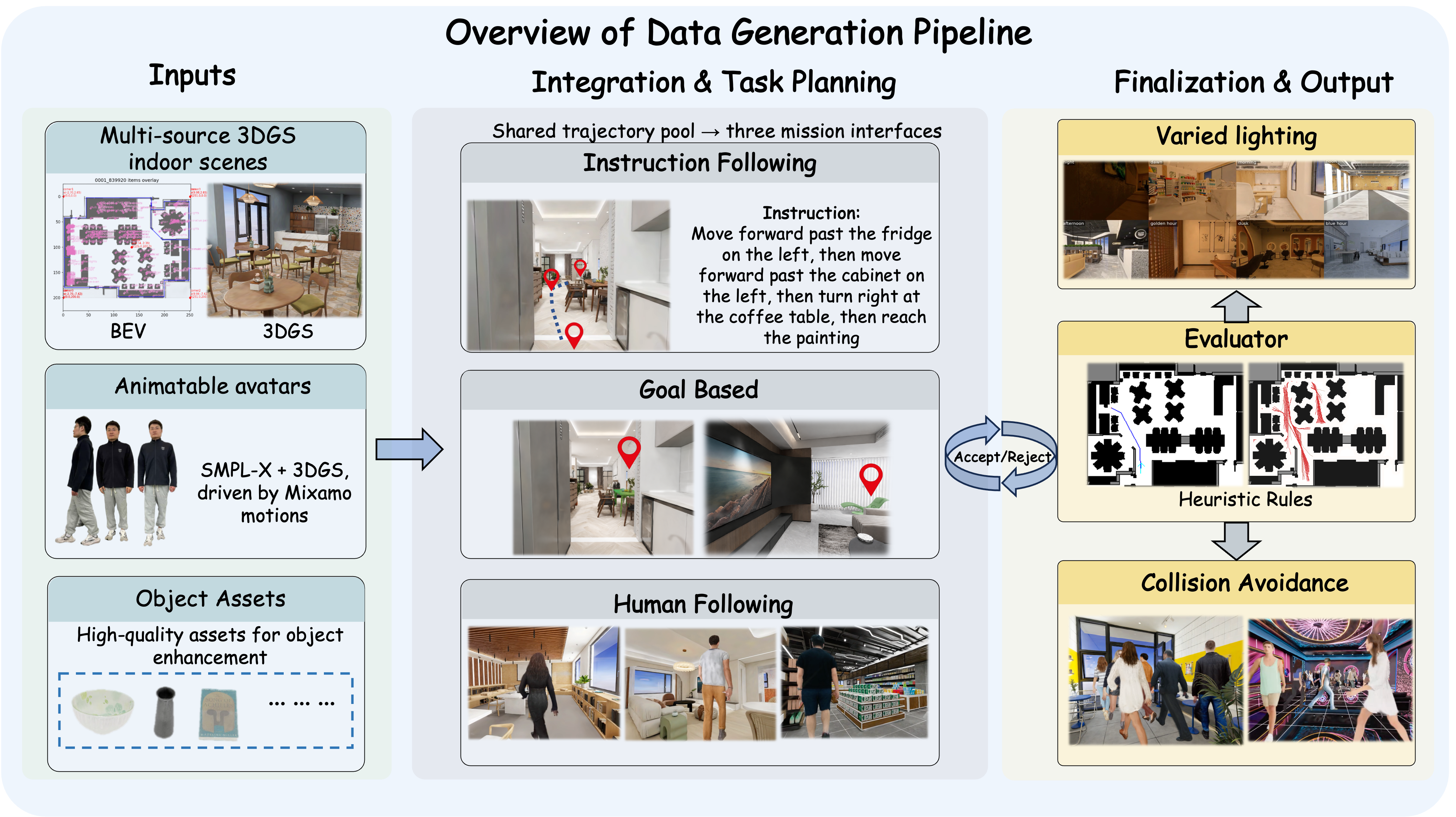
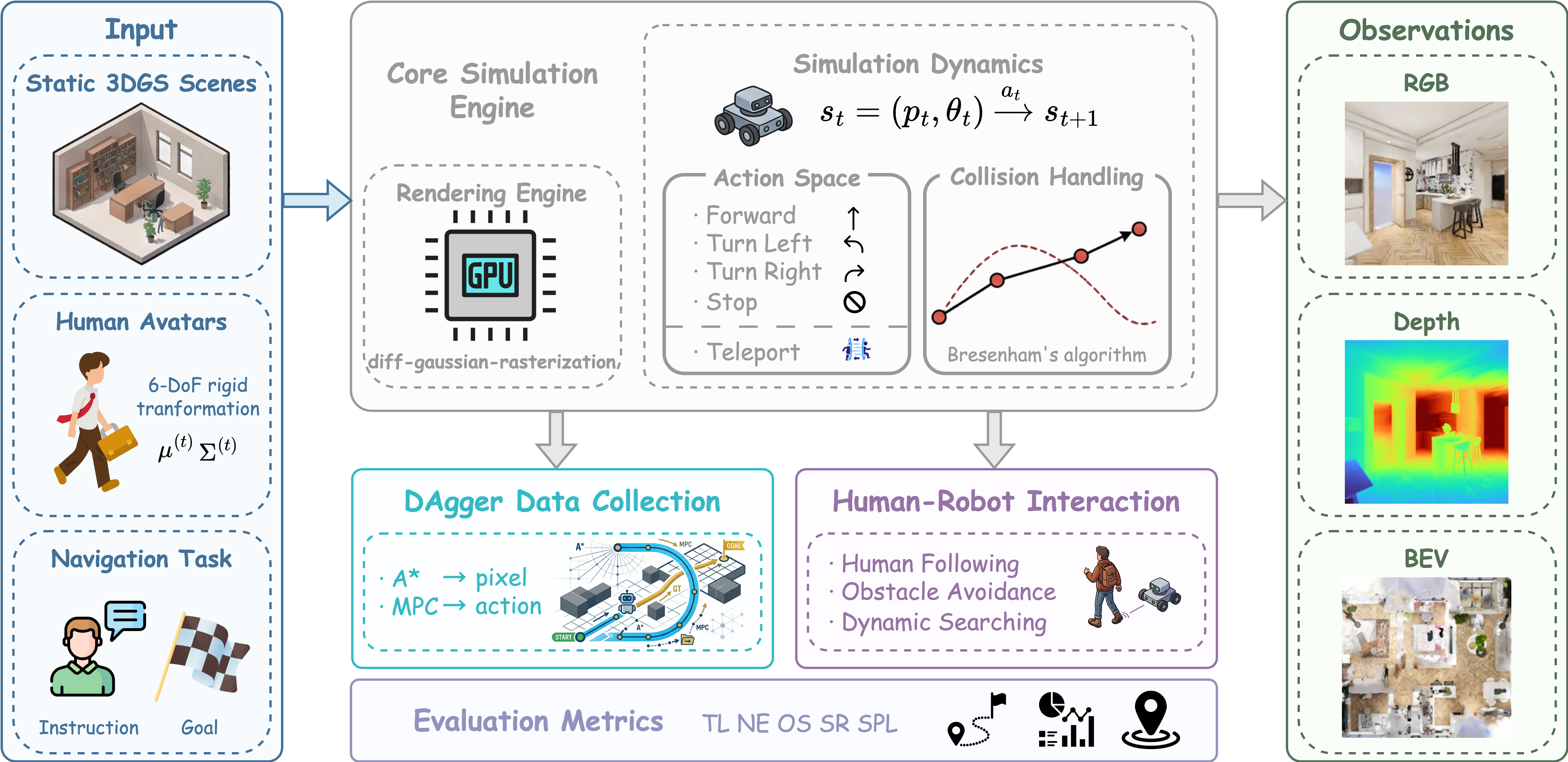
To bridge this gap, we curate diverse 3D scene resources and
develop an automated pipeline for large-scale navigation data
generation, resulting in the GN-Matrix dataset. Building upon a
3D Gaussian Splatting (3DGS) rendering engine, we further
introduce a high-fidelity simulation platform that supports
interactive roaming and collision-aware navigation. Furthermore,
we propose GN-Bench, the first benchmark to provide BEV-based
evaluation, incorporating dynamic 3DGS avatars to establish new
standards for human-robot interaction evaluation.
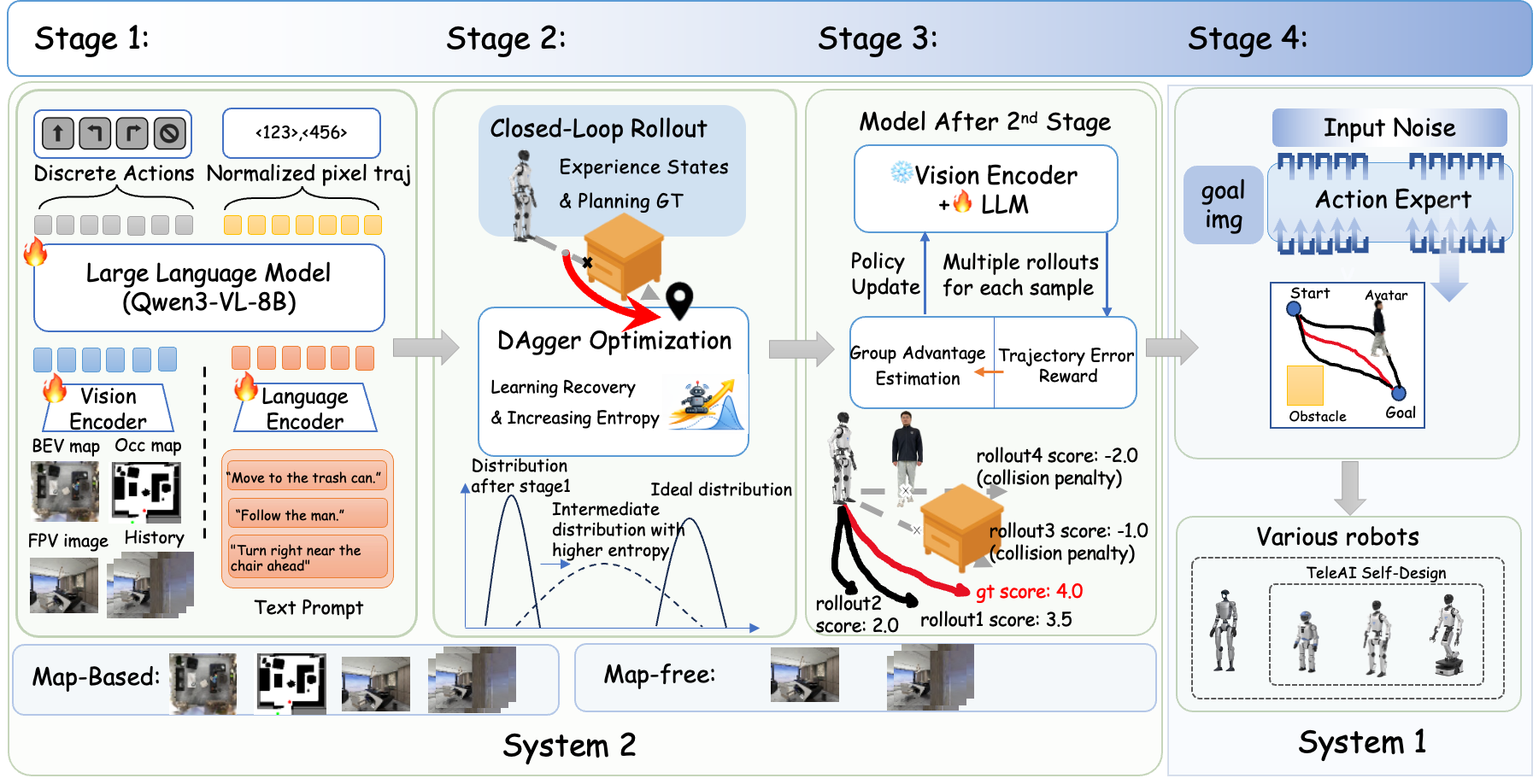
To fully leverage the interactive nature of the simulator, we
develop an RL-driven navigation foundation model, Break and
Establish (BAE), after supervised learning, DAgger exposes the
model to rollout-induced states and recovery behaviors beyond
idealized offline demonstrations, breaking the narrow
expert-centric distribution inherited from supervision and
providing a better starting point for downstream RL exploration.
This unified VLN paradigm seamlessly integrates both map-based
and map-free settings, enabling a broad spectrum of tasks
including instruction following, human following, and goal
navigation. To the best of our knowledge, this work is the first
to formalize high-fidelity 3DGS-rendered Bird’s Eye View (BEV)
representations as a compact and efficient memory mechanism,
thereby unlocking the latent spatial reasoning capabilities of
Vision-and-Language Models (VLMs). The dual-system architecture
of GN0 ensures both flexibility and high-efficiency deployment
in real-world scenarios.
Extensive evaluations on GN-Bench and VLN-CE, encompassing both
quantitative and qualitative analyses, demonstrate that the
proposed GN0 significantly outperforms existing state-of-the-art
VLN methods. Overall, this work, GN-Matrix, presents a unified
framework spanning data, simulation, and learning, offering new
insights for advancing embodied navigation in both academic
research and industrial applications.